A C++/Vulkan unofficial re-implementation of the Dressi-AD layer from the paper "Dressi: A Hardware-Agnostic Differentiable Renderer with Reactive Shader Packing and Soft Rasterization" (Takimoto et al., Eurographics 2022, arXiv:2204.01386).
 image_fitting |
 texture_optimization |
 silhouette (HardSoftRas) |
 silhouette (AA) |
 shape_texture_optimization |
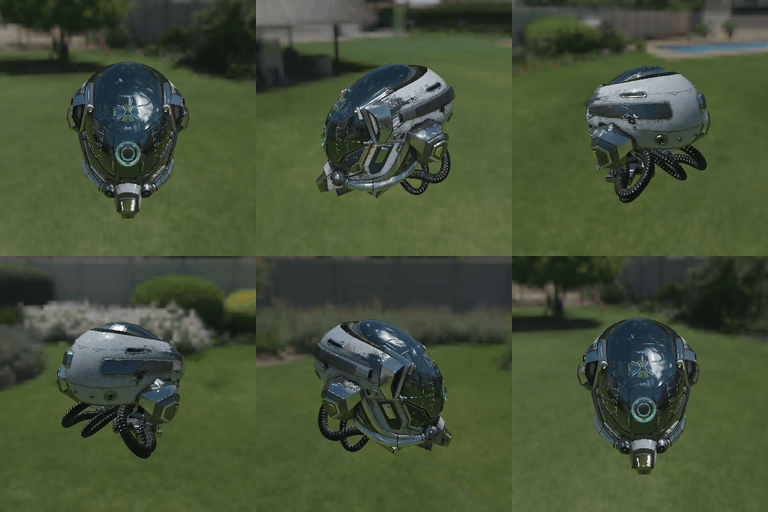 pbr_shading |
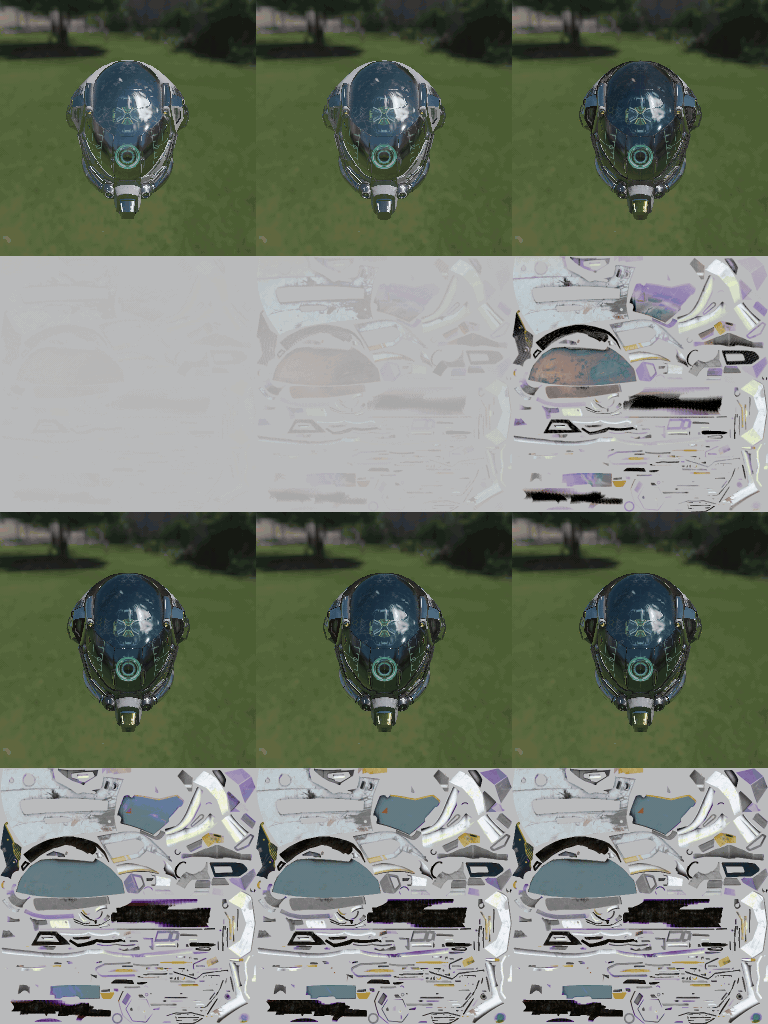 pbr_material_optimization |
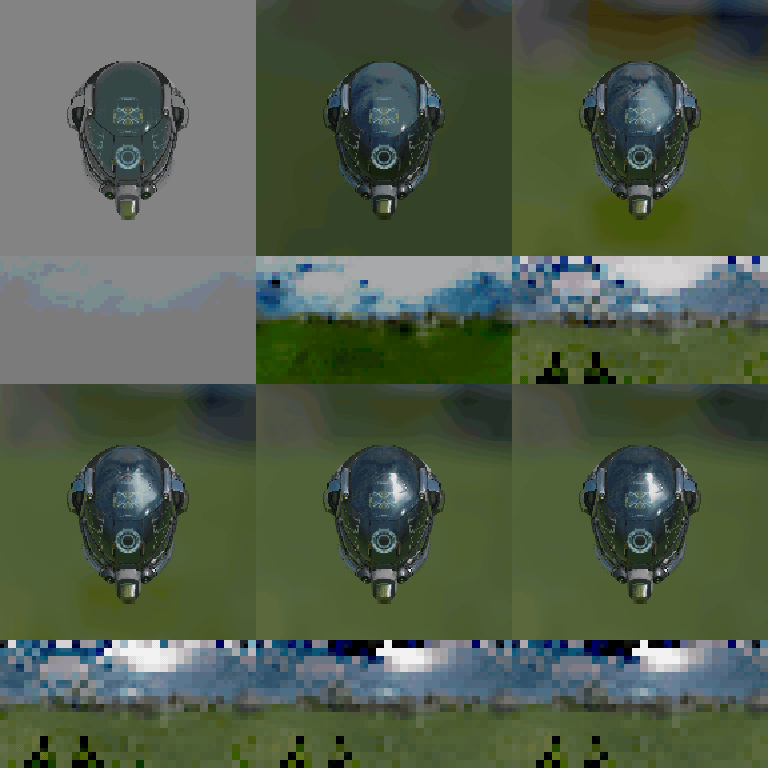 pbr_envmap_optimization |
All sequences are live optimization / rendering progress on the Vulkan engine (every example also runs unmodified on Android — see below):
📹 shape_texture_optimization on a phone — camera capture of the on-device run (Xiaomi 17T Pro, Dimensity 9500 / Mali-G1-Ultra), showing the target / prediction / recovered-atlas streams tiled on one screen (full-quality video):
shape_texture_android_web.mp4
Dressi-AD is a define-and-run reverse-mode automatic-differentiation framework specialized for differentiable rendering: computational graphs of 2D images are compiled to GLSL fragment shaders, packed into a minimal number of Vulkan render passes (Reactive Shader Packing), and executed on any Vulkan-capable GPU. Because the backend is portable Vulkan — not CUDA — the same graph runs on a workstation GPU, an integrated GPU, a pure-CPU software rasterizer, and a phone, to the same numerical quality. The public C++ API follows Appendix A of the paper.
Vertex-position gradients come from two techniques: HardSoftRas from the Dressi paper, and the differentiable screen-space anti-aliasing from "Dr.Hair" (Takimoto et al., CVPR 2024, arXiv:2403.17496). A split-sum PBR / IBL layer (physically based shading, material and environment-map optimization) builds on the same engine.
- Hardware-agnostic. One Vulkan engine, verified across 8 devices — three NVIDIA discrete GPUs, an Intel iGPU, two phones (Dimensity 9500 / Mali-G1-Ultra, Xiaomi 17T Pro and Dimensity 9200+ / Mali-G715, Xiaomi 13T Pro), a tablet (Snapdragon 8 Gen 2 / Adreno 740, Xiaomi Pad 6S), and CPU software Vulkan (llvmpipe).
- Faster than the baselines below 2048². Beats nvdiffrast (GL & CUDA) and DRTK at every resolution on the paper's silhouette task, by baking the whole forward + backward + optimizer into pre-recorded command buffers with zero per-iteration host traffic.
- Runs on phones, unmodified. Every example runs on Android with the same parameters and results as desktop (see README-android.md).
- PyTorch drop-in.
dressi.torchis an nvdiffrast-compatible API with no CUDA requirement.
- Building — Windows, Linux, Android, PyTorch bindings
- Examples
- Performance · full tables in docs/benchmarks.md
- How it works · details in docs/algorithm.md
- References · License · Layout
Common requirements: a Vulkan 1.1+ GPU, CMake ≥ 3.28, and the LunarG Vulkan
SDK (used for glslang; auto-detected — see below). The engine core is headless
(VkContext); GLFW/glad drive an optional live viewer only.
Build verified with Vulkan SDK 1.4.350.0 (desktop; the Android build
FetchContent-pins glslang / SPIRV-Tools / Vulkan-Headers to the matching
vulkan-sdk-1.4.350.0 tag). The engine creates its instance at API version
Vulkan 1.1, so it runs on any 1.1+ driver — see
docs/benchmarks.md for the runtime versions verified
across devices.
Visual Studio 2022, x64. The Vulkan SDK is auto-detected under C:\VulkanSDK\*
(no VULKAN_SDK env var required).
git clone --recursive <this repo>
cmake --preset msvc                # also downloads the example datasets
cmake --build --preset release
ctest --preset release             # all tests (labels: cpu / gpu)
ctest --preset release -LE gpu     # CPU-only tests (no GPU required)
./build/examples/Release/image_fitting.exeTested on Ubuntu 24.04 (gcc 14 / Ninja). Install the LunarG SDK tarball (no
root needed) under ~/vulkan/<version>/ — it is auto-detected (globs
~/vulkan/*, ~/VulkanSDK/*, /opt/vulkan/*; VULKAN_SDK still wins). A
system libvulkan loader + your GPU's ICD provide the runtime.
git clone --recursive <this repo>
cmake --preset linux
cmake --build --preset linux-release
ctest --preset linux-release
./build/examples/image_fittingandroid/ is an Android Studio project bundling all the examples into one APK
(Kotlin UI + JNI, live view on a SurfaceView, on-device GLSL→SPIR-V). Every
example completes with the same parameters and results as desktop. Build the
release variant for meaningful timings (the debug native lib is
unoptimized). Full instructions and on-device notes:
README-android.md.
cd android
$env:JAVA_HOME = "C:\Program Files\Android\Android Studio\jbr"
.\gradlew.bat :app:assembleRelease
adb install -r app\build\outputs\apk\release\app-release.apkPython deps are managed with uv (uv sync
creates .venv with CUDA torch; --extra nvdiffrast adds the comparison
backend). The bindings themselves need no CUDA — they run on any Vulkan GPU.
uv sync
cmake --preset msvc -DDRESSI_BUILD_PYTHON=ON -DPython_EXECUTABLE=.venv/Scripts/python.exe
cmake --build --preset release --target dressi_py
uv run pytest tests/pythondata/ is git-ignored (large / licensed) and populated at CMake configure
time by cmake/FetchAssets.cmake (hash-verified,
skipped if present). Pass -DDRESSI_FETCH_DATA=OFF to provision data/
yourself for offline builds.
| Path | Source | Size |
|---|---|---|
data/bunny/ (obj + mtl + atlas) |
kunzhou.net | ~3 MB |
data/Avocado/glTF/ (paper Table 4 mesh) |
glTF-Sample-Models | ~8 MB |
data/suburban_garden_4k.exr (PBS env map) |
Poly Haven | ~97 MB |
The examples ship as native executables (plus Python ports of the silhouette and texture ones):
# --- differentiable rendering core ---
./build/examples/Release/image_fitting.exe                       # smoke test
./build/examples/Release/texture_optimization.exe data/bunny     # inverse-UV texture grad
./build/examples/Release/silhouette_optimization.exe data/bunny --technique=hardsoftras
./build/examples/Release/silhouette_optimization.exe data/bunny --technique=aa
./build/examples/Release/silhouette_optimization.exe --mesh=data/Avocado/glTF/Avocado.gltf
./build/examples/Release/shape_texture_optimization.exe data/bunny   # shape, then texture

# --- physically based shading / IBL ---
./build/examples/Release/pbr_shading.exe                         # DamagedHelmet viewer
./build/examples/Release/pbr_material_optimization.exe           # albedo recovery
./build/examples/Release/pbr_envmap_optimization.exe             # environment recovery

# --- PyTorch (nvdiffrast drop-in; same code, either backend) ---
uv run python examples/python/silhouette_optimization.py                       # dressi (Vulkan)
uv run python examples/python/silhouette_optimization.py --backend nvdiffrast  # CUDA
A minimal C++ optimization loop:
Variable param(VEC3, {64, 64});
Variable target(VEC3, {64, 64});
Variable rendered = param / (param + 1.f);                        // graph of F:: ops
Variable loss = F::Mean((target - rendered) * (target - rendered));
param.setRequiresGradRecursively();

DressiAD ad;
ad.setLossVar(loss);
ad.setOptimizer([](Variables xs, Variables gxs) {                 // SGD
    Variables updated;
    for (size_t i = 0; i < xs.size(); i++)
        updated.push_back(xs[i] - gxs[i] * 0.01f);
    return updated;
});
ad.sendImg(param, init_img);
ad.sendImg(target, target_img);
for (int i = 0; i < 300; i++) ad.execStep();
CpuImage optimized = ad.recvImg(param);All figures are the median steady-state execStep wall time with a 20-iter
warmup excluded (the first steps pay a one-time pack + GLSL-compile + Vulkan
build). At ≤512² the wall is dominated by host submit/fence latency, not GPU
work (GPU timestamps total ~90 µs for HSR at 256² while the wall is ~0.34 ms),
so median (not mean) is the stable metric.
The identical backward graph runs from a workstation GPU, through an Intel integrated GPU, down to phones — to the same quality. Median ms/iter (default parameters):
| example (params) | RTX PRO 6000 | Iris Xe (iGPU) | Adreno 740 (tablet) | Mali-G1-Ultra (phone) | Mali-G715 (phone) | quality |
|---|---|---|---|---|---|---|
| image_fitting 64px | 0.056 | 0.32 | 0.23 | 1.01 | 2.04 | max err 0.0005 |
| texture_optimization 256px | 0.96 | 15.7 | 48.4 | 23.6 | 24.3 | 98.7% |
| silhouette (aa) 128px | 1.21 | 3.34 | 21.6 | 11.5 | 21.2 | IoU 0.95 |
| silhouette (hardsoftras) 128px | 2.16 | 9.96 | 23.7 | 32.5 | 36.6 | IoU 0.95 |
| pbr_material 256px | 2.73 | 17.9 | 55.2 | 40.9 | 47.0 | PSNR 20.6 dB |
| pbr_envmap 192px | 8.53 | 105 | 304 | 181 | 200 | PSNR 18.1 dB |
| pbr_shading 512px | 677 FPS | 116 FPS | 56 FPS | 19 FPS | 42 FPS | — |
Quality is device-independent (validated across all 8 devices). Verified on three discrete NVIDIA GPUs, the Intel iGPU, two phones (Dimensity 9500 / Mali-G1-Ultra, Xiaomi 17T Pro and Dimensity 9200+ / Mali-G715, Xiaomi 13T Pro), a tablet (Snapdragon 8 Gen 2 / Adreno 740, Xiaomi Pad 6S), and CPU software Vulkan (llvmpipe) — the full 8-device table, warmup and packing columns are in docs/benchmarks.md.
On the paper's one-view Avocado silhouette task, both techniques beat every baseline at every resolution — at 256² HardSoftRas K=1 is 0.15 ms vs nvdiffrast CUDA 1.11 ms and DRTK 2.12 ms; at 4096² AA is 0.78 ms vs 3.28 / ~220. dressi bakes the whole forward + backward + optimizer into pre-recorded command buffers with zero per-iteration host traffic, so below 2048² — where the PyTorch baselines are host-launch bound — it runs at the cost of the GPU work itself, and rematerialization keeps it ahead at 4096² too. The scaling shape matches the paper (fixed per-pass overhead at low resolution, pixel work above 1024²). Full tables (vs the paper's Table 4, vs nvdiffrast GL/CUDA and DRTK) and the discussion: docs/benchmarks.md.
Each DressiAD::execStep() walks the paper's InitStatus ladder — build backward
graph → wire optimizer → traverse → pack substages → pack stages → build Vulkan
objects → submit — and reruns each step only when its inputs changed (a reactive
cache), so a steady loop re-executes pre-recorded command buffers with nothing
crossing PCIe. In brief:
- Dressi-AD core + Reactive Shader Packing. Image-op graphs (
Variable/F::) compile to GLSL; a greedy packer fuses same-pixel chains into minimal Vulkan render passes under each device's limits, then rematerializes cheap producers and drops dead outputs. Every op has a CPU kernel checked by finite differences. Losses stay images; the optimizer writes updates in-place (zero-copy aliasing). - Deferred rasterization + texture optimization.
F::Rasterizewrites G-buffer channels;F::Textureis differentiable w.r.t. the texture via the paper's inverse-UV lookup (with Sobol-jittered sampling for full coverage). - Vertex-position gradients.
F::RasterizeSoft(HardSoftRas,--peels=K) andF::AntiAlias(Dr.Hair screen-space AA) flow gradients to 3D positions; the fully GPU-resident silhouette loop reaches IoU ≈0.95 at the demo defaults (≈0.98 with exact gathers and longer runs) with zero per-iteration CPU traffic. - PyTorch bindings.
dressi.torchis an nvdiffrast drop-in backed by the Vulkan engine (no CUDA), reconciling eager ⇄ define-and-run with a shape-signature engine cache; a native-fused path matches C++ speed from Python. - PBR / IBL. Split-sum Cook-Torrance shading with material and environment-map optimization; all equirectangular, with exact-transpose backwards for the environment ops. The environment is recovered from the object's shading and reflections alone (foreground-masked loss — the metallic helmet constrains almost the whole sphere).
Full details — every op, the packing / rematerialization passes, the WIDE gather backwards, the PyTorch engine cache, and known deviations from the paper — are in docs/algorithm.md.
This repository re-implements techniques from the following papers. If you
use this code in academic work, please cite them — the Dressi paper for the
renderer as a whole (Dressi-AD, Reactive Shader Packing, HardSoftRas), and
additionally the Dr.Hair paper when you use the screen-space anti-aliasing
vertex gradients (F::AntiAlias).
@article{takimoto2022dressi,
  title   = {Dressi: A Hardware-Agnostic Differentiable Renderer with
             Reactive Shader Packing and Soft Rasterization},
  author  = {Takimoto, Yusuke and Sato, Hiroyuki and Takehara, Hikari and
             Uragaki, Keishiro and Tawara, Takehiro and Liang, Xiao and
             Oku, Kentaro and Kishimoto, Wataru and Zheng, Bo},
  journal = {Computer Graphics Forum},
  volume  = {41},
  number  = {2},
  pages   = {13--27},
  year    = {2022},
  doi     = {10.1111/cgf.14455}
}

@inproceedings{takimoto2024drhair,
  title     = {{Dr.Hair}: Reconstructing Scalp-Connected Hair Strands
               without Pre-training via Differentiable Rendering of Line
               Segments},
  author    = {Takimoto, Yusuke and Takehara, Hikari and Sato, Hiroyuki and
               Zhu, Zihao and Zheng, Bo},
  booktitle = {Proceedings of the IEEE/CVF Conference on Computer Vision
               and Pattern Recognition (CVPR)},
  pages     = {20601--20611},
  year      = {2024},
  doi       = {10.1109/CVPR52733.2024.01947}
}MIT (see LICENSE). Third-party dependencies keep their own licenses: VulkanWrapper (MIT, a fork of takiyu/VulkanWrapper with Vulkan SDK 1.4.x patches), glad (generated loader), GLFW (zlib), tinyobjloader (MIT), stb (public domain / MIT), spdlog (MIT), GoogleTest (BSD-3), tinyexr (BSD).
include/dressi/   public API (Appendix A style)
src/core/         graph nodes, F:: ops, BuildBackward, CPU evaluator, IBL math
src/codegen/      substage -> GLSL fragment/compute shader generation
src/pack/         trivial & greedy (RSP) packers, reactive pruning
src/vk/           headless Vulkan context, executor, CPU<->GPU transfer
src/python/       nanobind module (dressi._C) + dressi.torch eager API
examples/         image_fitting / texture_optimization / silhouette_optimization
                  / shape_texture_optimization / pbr_shading
                  / pbr_material_optimization / pbr_envmap_optimization
android/          one-APK Android app (all examples; Kotlin + JNI)
tests/            GoogleTest suites (ctest labels: cpu / gpu) + tests/python